

For those of you who don't know how to read hieroglyphics, that says "Jenny and Byram went to Egypt for vacation. They had a wonderful time seeing sites along the Nile river. They were amazed by the beautiful temples that were built thousands of years ago."
We started our vacation by flying from Boise to Salt Lake. Grandpa Pepper picked us up at the airport and treated us to a late lunch. We then returned to the airport and flew to Paris. Long, grueling, and sleepless pretty much sum up that flight.
 |
| Our chipperness didn't last all that long. |
 |
| The food on the flight over left a lot to be desired. I forgot to take pictures of the other meals, but the meals on Air France were quite good, and the meals on the return Delta flight were also pretty good. |
We had a two hour layover in Paris, so we bought some breakfast. Jenny really wanted to have breakfast in Paris.
 |
| Nothing like a few thousand calories to make you feel a lot better about not sleeping for way too long! |
Cairo is an interesting city. It has a population of about 22 million people, with an additional 7 million visitors a day. Driving around the city is insane. Nobody pays attention to lanes, speed limits (I only saw one or two), or much of anything. You see everything on the road, including vans, cars, motorcycles, motorcycle taxis, camels, donkeys pulling carts, cows, sheep, and people. We arrived the night before Eid al-Adha (the feast of Ibrahim [Abraham]). It is one of two holidays celebrated by the Muslim people. As part of the feast, the people sacrifice animals and divide the meat among friends and the poor. Since we arrived the night before, we saw tons of animals that normally wouldn't be in the city, but were there in preparation for the sacrifices.
Our hotel was Le Meridian Pyramids. It is super close to the pyramids. You can see the great pyramid as you lounge in the pool. The hotel itself was pretty nice and the food was good. We only spent a couple nights at that hotel.
Cairo
Our first full day in Egypt was spent exploring the major sites. We started with the Pyramids of Giza since they were so close. At the Great Pyramid (Pyramid of Khufu), built around 2560 BC, our Egyptologist gave us some info on the pyramid. We then spent some time climbing up a little ways on the pyramid itself.


 |
| The hole in the center is known as the Robber's Tunnel. Tomb raiders broke into the pyramid at this point around 820 AD. |


 |
| This is Kareem, our Egyptologist and budding photographer. |
We also had the opportunity to take a short camel ride near the pyramids.


A brief trip to the other side of the Pyramid complex led us to the great Sphinx.

 |
| Jenny got a little frisky with the Sphinx! |
After viewing the sights at the Pyramid complex, we headed towards Memphis. On the way, we stopped at a little restaurant and village complex for an authentic oriental lunch. In Egypt, they call Egyptian food oriental food. On the way in, we saw a woman who was making flat bread, similar to a pita. We watched her making the bread and put it into a brick oven. She let Jenny try to do it. She then gave us a hot piece of bread straight from the oven.


Lunch itself was lamb and chicken served hot from a little hibachi type grill. We had more flat bread that we could dip into several dipping sauces, including tahini. We also had some fries made from something similar to potatoes.

After lunch we went to the Pyramid of Djoser. It is considered to be the first Egyptian pyramid, built between 2667 and 2648 BC.
 |
| This is the entrance to the pyramid complex |
 |
| This is the other side of the main entrance. |
 |
| The pyramid of Djoser. It is also known as the step pyramid. |


Inside the burial room, we saw the sarcophagus.


A short drive away, still in Memphis, was the Ramses II museum. The main attraction at the museum was a colossal statue of Ramses II. It is about 3200 years old and would have stood about 30 feet high.


In the same courtyard as the Ramses statue are a couple other statues worth noting. One is the alabaster sphinx. It is much smaller than the great sphinx of Giza, but we were able to get much closer.


Jenny also liked the statue of the goddess Hathor. This was our first encounter with Hathor, but we learned a lot more about Hathor later in the trip. She is known as the cow goddess due to the distinctive ears. Because of the ears, she was also one of the easiest people to recognize as we visited the other sites.

Our second day in Cairo was Jenny's day. We had a full day of relaxation. We had a late breakfast, lounged around the pool for a couple hours, had a late lunch, and then had 2 hour massages. Jenny loved hers. That was likely my one and only massage for my lifetime. We then spent some time picking out gifts in the hotel gift shop, had dinner, and went to bed.
Luxor
We started day three by driving to the airport where we caught a short flight to Luxor. When we got to Luxor, we met our second guide, Hamada. We then went to our boat and got settled into our room. Here are a few pictures of the boat:


 |
| This was our home away from home. |
 |
| This is our group on the top deck of the boat. Counter clockwise from Jenny are Fred, Kathy, Nancy, and Jo. The guys with his back to the camera was showing how to write our names in hieroglyphics, and trying to sell us jewelry at the same time. |
The temple complex at Karnak is one of the oldest and largest religious sites ever built. It was started around 1971 BC to around 30 BC. Karnak can be divided into four sections: south Karnak (temple of the goddess Mut), east Karnak (temple to the god Aten), north Karnak (temple of the god Montu), and central Karnak (temple to the god Amun). The only part open to the public is parts of the temple of Amun.
With Karnak, one pharaoh would start to build a temple. Then another pharaoh would add onto it. Then another pharaoh would add on to that. This continued for thousands of years.
It is hard to get a scale for how large this temple complex is and where all the pictures fit in. I found this rendering from UCLA of what the temple of Amun would have looked like. If you watch it, you will have better idea of where at the pictures that will follow were taken. The video gives you an overview, but it fails to communicate the awesome scale. Don't fret though, the pictures will show just how awesome the ancient Egyptian builders were. (If the video doesn't work, click here)
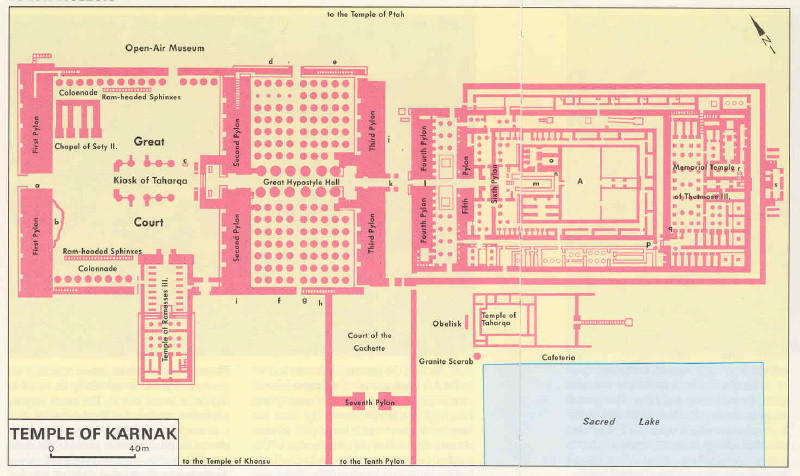 |
| This map gives a better idea of what the are we visited looks like. |
Our tour began outside the first pylon. Lined up outside the walkway, we found a row of sphinxes on each side. We found sphinxes all over Karnak. In fact, recent excavations show that there was an avenue connecting Karnak to Luxor, with a row of sphinxes on each side. The entire 1.5 mile path is being excavated and restored.
 |
| This is our guide, Hamada leading the way to the first pylon. |


Once you pass through the first pylon, you come to a large courtyard. There are several more statues and sphinxes in this courtyard. We didn't go into any of the rooms or courtyards that extended off of this courtyard.


Heading farther in, you pass through the second pylon and enter the massive hypostyle hall. The hall is over 50,000 square feet, with 134 columns in 16 rows. The columns in the two middle rows are taller than the rest of the columns, at around 80 feet high. The middle row columns are around 33 feet around.


One interesting thing our guide pointed out is that the columns were designed to look like a lotus plant. When the column is in an area where light will hit it, it is depicted as being open. When the columns will not be in the light, the column depicts a closed lotus. You see this design all over Egypt.
 |
| Open |
 |
| Closed |

The walls of the hypostyle hall are filled with hieroglyphics. One thing our guide pointed out was how the ancient Egyptians communicated that more than one person or thing was involved. If you look at the following hieroglyphics, you see 7 rows of people carrying the pharaoh, who is in a boat.

If you zoom in, you see that each person in the first 3 and last 3 rows has 5 images depicted. This was how the ancients would communicate that 31 people were carrying the pharaoh.
 |
| Horus is in the front. |
 |
| Anubis is in the back. |
The hypostyle hall ends at the third pylon. If you turn right (south) between the third and fourth pylons, you see the axis for the seventh through tenth pylons. We didn't get to see much of the seventh through tenth pylons because that area is under reconstruction. The picture below is a view of the axis leading through those pylons. The statues out front were not there originally. At one point, one of the stones that was being moved by a crane broke loose and landed on a statue and severely damaged it. Rather than risk further damage, they moved all the statues outside the work area. Once the reconstruction is completed, these statues will be put back in place.

Just to the left (east) of the axis in this picture, is the sacred lake.

Next to the sacred lake is a large scarab beetle. Our guide told us that if you walked around it three times, a wish you wish for yourself would granted. If you walked around it seven times, a wish you wished for someone else would be granted.

After walking around the scarab beetle, we went back to the main axis of the temple and entered the holy of holies. The room itself was empty, but the ceiling was beautiful. You can still see the blue sky with white stars that had red centers.

On the outside of the holy of holies, we came across more hieroglyphics. Jenny really like the story on this wall, but I can't remember why.


The last noteworthy things we saw at Karnak were the obelisks. Obelisks were carved from a single slab of granite in a quarry near Aswan. Once cut, it was shipped by boat down the Nile river to its destination.
Two obelisks are still standing in Karnak, and one that has fallen in still visible. All the rest of the obelisks that used to stand in Karnak have been moved elsewhere. In the picture below, you see the two standing obelisks.

On the left, between the third and fourth pylons, is the obelisk of Tuthmosis I (Tuthmose I). It is about 66 feet high and weighs about 143 tons. On the right, between the fourth and fifth pylons is the obelisk of Hatshepsut. It is about 97 feet high and about 323 tons.
If you look closely, you can see that Hatshepsut's obelisk changes color part way up the shaft. Our guide told us that this was because Hatsphesut's son did not believe she should have been the pharaoh. Since the obelisk was dedicated to the God Amun, her son couldn't destroy it for fear of offending Amun. Instead, he built a wooden wall around the obelisk to prevent people from seeing the inscriptions showing how Hatshepsut was accepted by Amun. The wall didn't go all the way up, so part of the obelisk was in shadows, part was subjected to the sun's rays.


Hatshepsut built another obelisk near this one, but it has since fallen over. The top of it can be seen near the sacred lake.

Here are a few more random pictures from Karnak.
 |
| Notice how deep the hieroglyphics are carved. Our guide told us this was to prevent someone else from wiping out what was written and putting their own story on the wall. This was a common practice, especially with Ramses II. |
 |
| Jenny found this kitty by the sacred lake and had to take a picture for our girls. |
 |
| This guy really needs a break from studying. If he doesn't get up soon, he will loose his head! |
 |
| One of these statues appears to be slightly newer, but I can't quite figure out what is different. Maybe its the smile that says "I want to kill my husband for making me do this." |
After a short jaunt from Karnak Temple, we began to explore Luxor temple. We had a little excitement when we first got there. At most of the sites we visited, we have to scan our bags and go through a metal detector. After putting our camera bag through the scanner, the guards got excited and started a rather festive argument with our guide. We had no clue what was being said (it was in Arabic), but our guide kept telling us just to walk away and to to the temple. Later on, he explained that they wanted to charge us an extra admission because I had a small tripod in the camera bag. Our guide promised we wouldn't bring it out, and they let us pass.
The first thing you see when you get to Luxor temple is the avenue of sphinxes that leads towards Karnak temple.


Looking the other direction, you see the Temple itself. The temple was initially constructed by Amenhotep III, but was enlarged by Ramsesses II. At first, Ramssess paid tribute to Amenhotep, but after 30 years, he erased Amenhotep's name and put his name on everything.

In the following picture, you see a lone obelisk. Up until 1833, it had a twin sitting on the other side of the main gate. In 1833, the second obelisk was moved to Paris.


Seated outside the main gate are two colossal statues of Ramses II. In this picture you can see the obelisk to the left. You can also see the pedestal for the missing obelisk on the right.

One thing that is fascinating is that many of the temples were put to other uses through the ages. For many of the temples, the yearly flooding of the Nile river brought sand and silt. Year after year, it accumulated. Without constant upkeep, many of the sites became fully or partially buried. At Luxor, the sand buried a good portion of the temple. In the following picture, you can see what used to be the main floor entrance to an Islamic Mosque, built around the thirteenth century AD. Below that, you find windows. Those windows were for a Coptic church that was used around the sixth century AD. The main entrance the mosque was moved to the other side when excavations were done to the Luxor temple.


In the main court on the side, you find several statues of Ramses and Amenhotep.

At the far end of Ramses courtyard, you find two more colossal statues of Ramses sitting. The one on the right is remarkably well preserved.


Following are some more pictures or Luxor temple that don't really fit into a category.
 |
| Columns in Amenhotep's court. |
 |
| Hieroglyphics with amazing color. |

 |
| Jenny was incredibly popular with the locals. At nearly every location, she would have people come up to her and ask for a picture with her. |
 |
| At one point in Luxor, it got so bad that she had a line of people queuing up for pictures. Our guide had to yell at them to leave her alone. |
 |
| This is a basic map of the layout of the tombs. |
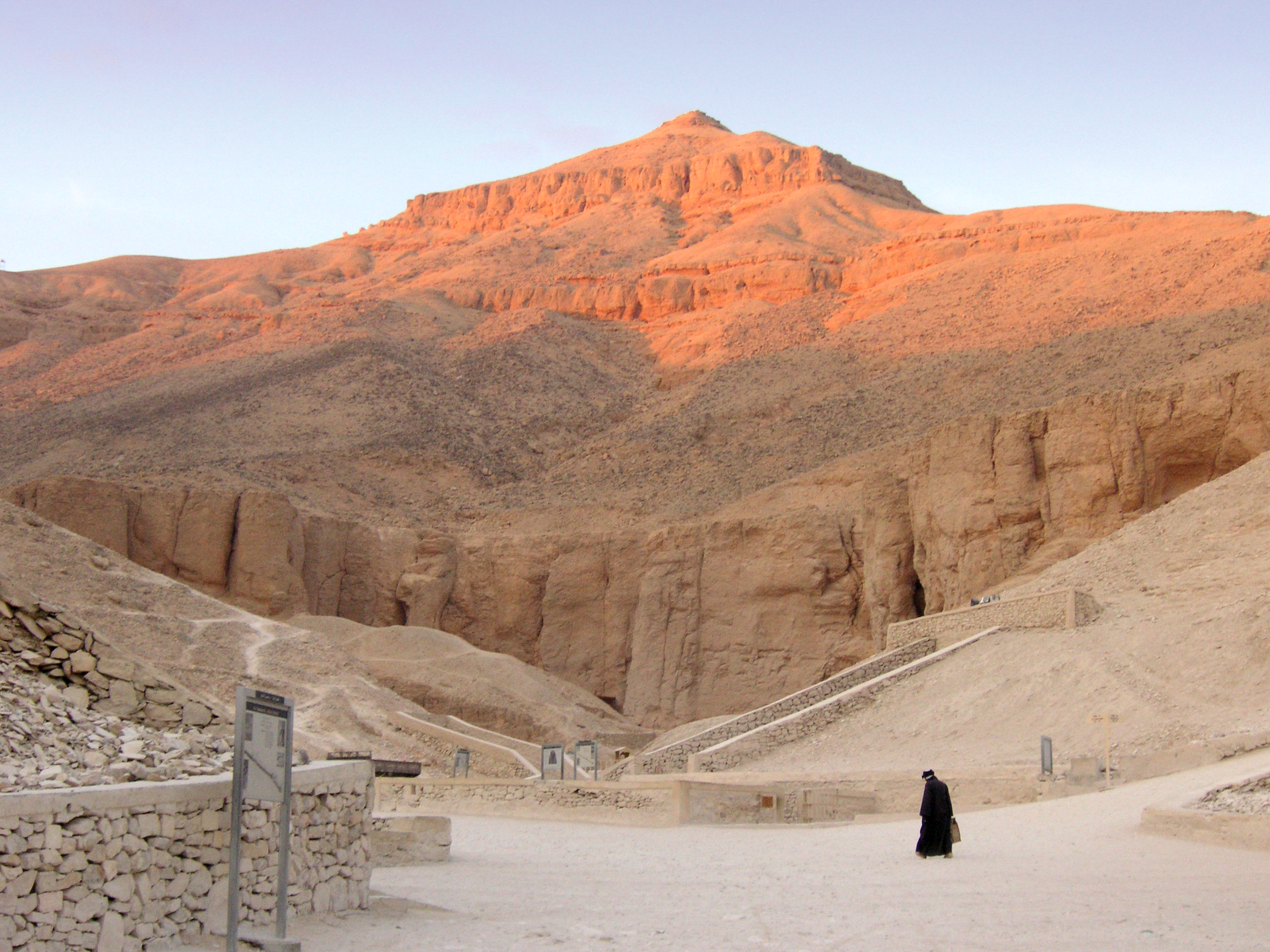 | ||
| The Valley of the kings is overshadowed by a large mountain that resembles a pyramid.
The Valley of the Kings was used as the burial place for pharaohs and nobles from the 16th to 11th centuries BC. There are currently 63 known tombs or chambers. Exploration continues for at least one missing tomb. Just today (9 November 2015), I read in the news that they believe King Tut's tomb may has a false wall that is covering a secret chamber.
Although there are 63 chambers, only around 15 are open to the public, but not all at the same time. We were able to visit 3 with our ticket. We visited the tombs of Ramesses IX (KV6), Merenptah (KV8), and Ramesses IV (KV2). The KV represents Kings Valley, and the number is the order of discovery. You can find the number on the map above. If you want to see pictures of these tombs, you will have to Google them. I found this site while looking up info on the Valley of the Kings. It has a lot of good info and videos of several of the tombs.
From the Valley of the Kings, we went a short distance to the Temple of Hatshepsut.

This is what the site looks like today.
Hatshepsut was the longest reigning female pharaoh. She is also considered to be one of the most successful pharaohs. She ruled from about 1473 to 1458 BC. She established trade with several other areas, which allowed Egypt to prosper. She used this prosperity to built lots of monuments and buildings to herself and the gods. Her stepson, Thutmose III tried to remove her name from many of her monuments after she died because he didn't like the fact that she had been the ruler instead of him. Following are a bunch of pictures from the temple.    
Jenny in front of a statue of Hatshepsut. To look like a pharaoh, she portrayed herself with a false beard.

Each column of the temple originally had a statue of Hatshepsut in front of it.

Entrance to the inner sanctuary.

Look at the amazing coloring!
  
This is a pillar with Hathor's head.

If you look carefully, you can see Hatshepsut getting a drink of milk.
On the way back to the boat, we stopped to view the Colossi of Memnon. They are all that remains of the mortuary temple of Amenhotep III (ruled from approximately 1386 to 1349 BC). This temple was the largest and most opulent temple in ancient Egypt, but today about the only thing that remains are two colossal statues of Amenhotep III that used to guard the main entrance. The temple was constructed closest to the Nile of any ancient temples, so it suffered more from moisture and flooding than other temples. It was also raided to build other temples. In 2004, excavations of the temple area were commenced.
The statues are believed to have been almost identical, apart from different inscriptions and minor artwork. The statues were damaged (along with almost everything near Luxor) by a massive earthquake in 27 BC. Both statues were originally carved from a single piece of stone. The statue on the right fared worse in the earthquake. During the ancient Roman Empire, an attempt was made to reconstruct the right statue, which is why you see several blocks stacked from the waist up.
If you look closely, you can see smaller carvings of women on the outside of Amenhotep's legs on each statue. These depict his mother, wife, and a daughter.
  |


1 comment:
What a time of your life! You have everybody jealous. But I got a bottle of sand from the Sahara Desert cool! Thanks for posting the pictures Byram. Don't delete them before I can get a copy! Very nice pictures. Very fun vacation. Very cute couple!
Post a Comment